Copy the link to a markdown format of this article for ChatGPT, Claude, Gemini, or your favorite AI.
Editing the WordPress database can feel intimidating, and for good reason. Apart from a few static files, the database stores everything that gives your site its identity: posts, pages, users, settings, and plugin configurations. A database editing mistake can break features or take your site offline.
But sometimes, editing the database is the only option, and it’s often the most convenient. For example, when you migrate a WordPress site to a new domain, the URLs stored in the database have to be changed. The quickest way to do that is a mass database edit.
The good news is that you don’t need to be a developer to make safe, meaningful changes to your database. In this article, we’ll walk you through when and why you might need to edit your database, what can go wrong, and how to do it safely.
What Is the WordPress Database?
The WordPress database is where your site’s dynamic content lives. When someone visits a page, WordPress pulls data from the database and assembles the page on the fly using PHP. On a blog post or product page, it includes the post content, title, menu structure, widget settings, and so on.
Behind the scenes, WordPress uses MySQL or MariaDB to store its data in structured tables. Each table is responsible for a different type of content or configuration. Some hold user information or site settings, while others store posts, pages, and plugin data.
Most WordPress sites use a table prefix like wp_, but that can vary depending on your setup. The tables you are most likely to encounter include:
wp_posts: Stores all posts, pages, attachments, and custom post types.
wp_postmeta: Holds metadata associated with content, such as custom fields.
wp_users: Contains all user accounts and login credentials.
wp_usermeta: Stores user preferences, capabilities, and roles.
wp_options: Includes global site settings like the site URL, time zone, and active plugins.
wp_comments: Stores comment content and authorship data.
wp_commentmeta: Contains additional metadata for comments.
wp_terms, wp_term_taxonomy, wp_term_relationships: Used for organizing content into categories, tags, or custom taxonomies.
Why You Might Want to Edit the Database
WordPress gives you all the tools you need to manage your site day to day without ever touching the database. But there are situations where the Admin interface falls short, or where a plugin leaves behind data that can’t be cleaned up through normal means.
We’ve already mentioned mass URL renaming, but here are some other reasons you might need to access and edit your WordPress database directly:
Updating an author’s display name: WordPress stores the display name in the wp_users table. If a contributor changes their name, you may want to update how it appears on published content.
Cleaning up plugin remnants: Deleting a plugin doesn’t always remove the data it added to your database. Settings, custom tables, and metadata often remain behind. You may also find that removing a plugin leaves non-functioning shortcode tags on posts and pages that are time-consuming to remove manually.
Bulk deleting spam or inactive users: If your site has collected spam accounts or dormant user profiles over the years, cleaning them out one at a time through the dashboard isn’t practical.
Changing configuration values that break the admin panel: Misconfigured theme or plugin settings in the wp_options table can make the admin area inaccessible. Editing these values directly in the database may be the only way to recover access.
What Can Go Wrong
Editing the WordPress database can cause serious issues. Some will be obvious: the Dashboard failing to load, for example. Others may only show up later as broken features or lost data. Before you make any changes, it’s important to understand what can go wrong and how to avoid it.
Breaking Serialized Data Structures
Many WordPress settings are stored as serialized data. Instead of plain text, the database field contains complex values like arrays and objects converted into a specially formatted textual representation.
The problem is that serialized strings include length markers that must match the exact number of characters in each value. If you do a basic search-and-replace using a tool that doesn’t understand serialization, you might update the text but not the character counts. That small mismatch corrupts the entire setting.
To avoid this issue, only edit the database with serialization-aware plugins and tools. These tools understand serialization and how it’s used in the WordPress database.
Deleting the Wrong Data
It’s easy to run a query that deletes more than you intended. For example, deleting users with a shared role or metadata key could wipe out admin accounts, not just spam users. If you’re editing live data without a recent backup or a safe test environment, those mistakes may be unrecoverable.
Locking Yourself Out of the Admin Dashboard
Accidentally changing site URLs or user permissions can prevent you from logging in to the dashboard. In some cases, even loading the login page will trigger an error. Fixing a broken dashboard may require further direct database edits or command-line configuration changes with WP-CLI.
Creating Subtle, Hard-to-Diagnose Bugs
Not all problems show up right away. If you mistype an option name, delete a database row that a plugin depends on, or corrupt a piece of post metadata, your site might seem fine until a form stops working or your layout breaks in certain browsers.
Before You Begin: Make a Backup and Use a Staging Site
Before you make any changes to your live site’s database, create a full backup and test your changes on a staging site. A backup gives you a restore point if something goes wrong. A staging site lets you safely test your changes in an isolated environment before pushing them live.
If you’re a Pressable customer, both are built in:
If you’re not using Pressable, you’ll need to back up your files and database manually or use a plugin like UpdraftPlus. For staging, some hosts offer built-in tools, or you can manually create a clone of your site in a subdomain.
However you do it, never make direct database changes without a way to undo them. Even small edits can have unintended consequences.
Safe Methods for Editing the WordPress Database
When it comes to editing your WordPress database, the tool you use matters. The safest option depends on what you’re trying to do, your comfort level with technical tools, and whether the data you’re editing is structured (like serialized content) or simple text.
Here are three common ways to safely make changes, from most beginner-friendly to most advanced.
Use a Plugin
If you need to search and replace text in your database to clean up leftover shortcodes or fix hardcoded links, a plugin is often the easiest and safest approach.
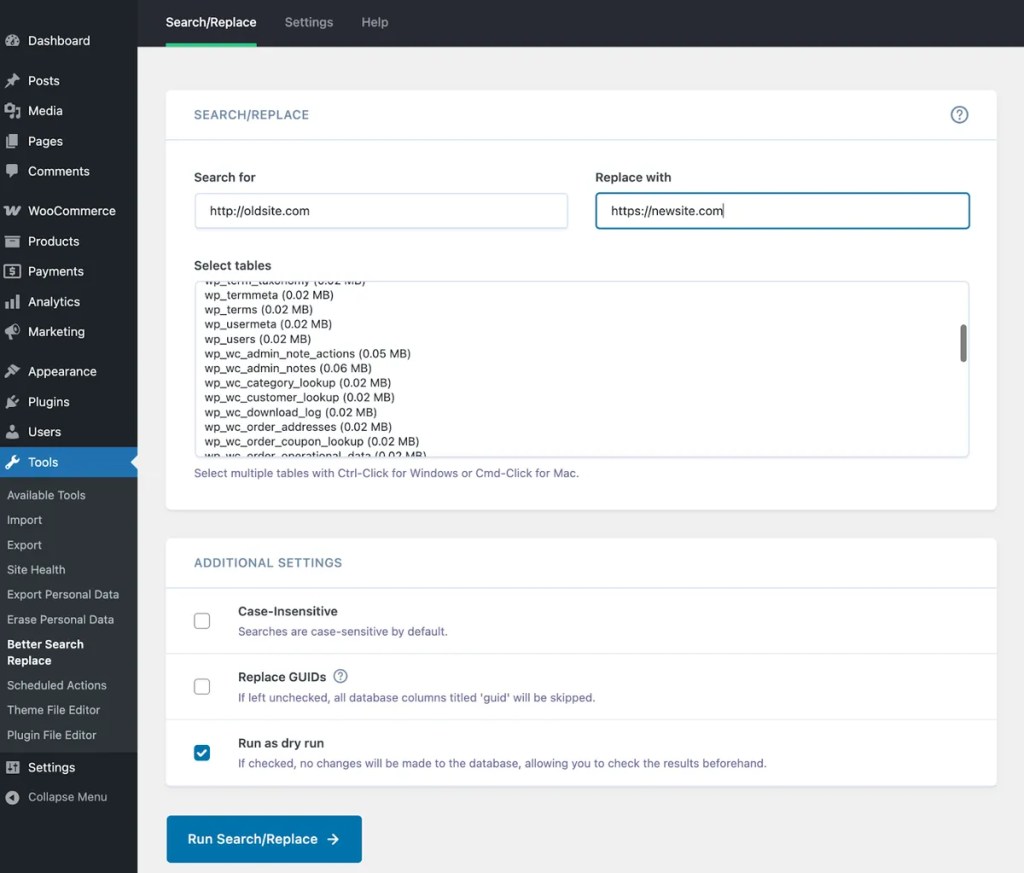
Tools like Better Search Replace are built to handle serialized data correctly and include a dry run mode so you can preview changes before applying them. They are ideal for straightforward search-and-replace operations.
Here’s how you’d run a URL search-and-replace with Better Search Replace:
1. Install and activate the plugin. 2. Go to Tools > Better Search Replace. 3. In the “Search for” field, enter the old URL. 4. In the “Replace with” field, enter the new URL 5. Select all tables. 6. Enable “Run as dry run?” and click Run Search/Replace. 7. If the results look correct, uncheck dry run and run it again to apply changes.
WP-CLI is a command-line tool for managing WordPress sites. If you’re comfortable using a terminal, WP-CLI is powerful, fast, and serialization-aware. We explained how to use WP-CLI here.
For example, you can perform a safe search and replace like this:
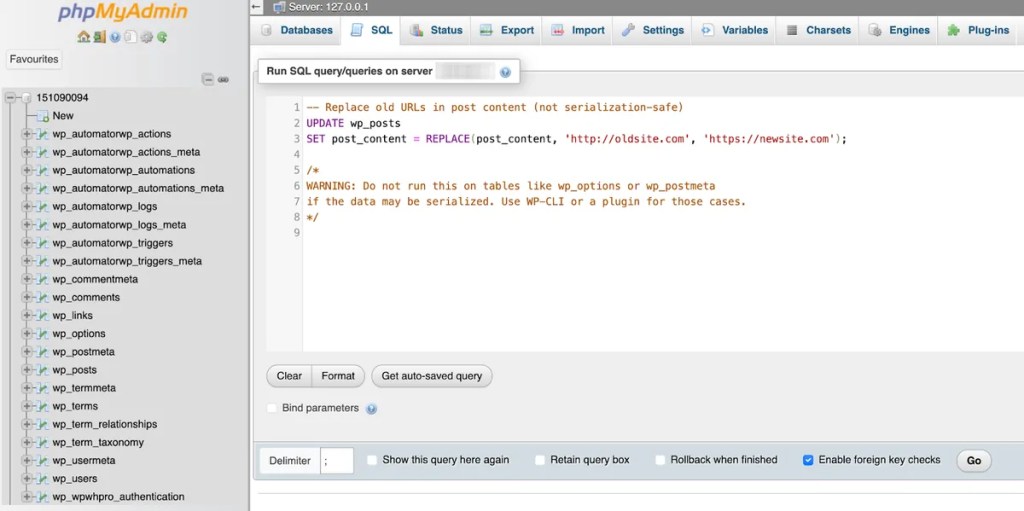
phpMyAdmin is a web-based tool for interacting directly with your database. It’s extremely powerful, but you really have to know what you’re doing. It is not serialization-aware, so it is not safe to use on tables like wp_usermeta and wp_options that contain serialized data.
Unless you’re a database and SQL expert, the other options we’ve discussed are less risky.
phpMyAdmin gives you full access to your database tables, rows, and queries. That includes the power to run raw SQL commands or edit individual fields. You can also create and restore database backups with phpMySQL’s Export and Import tools.
For example, you could use phpMyAdmin to change a user’s display name by running the following SQL query in phpMyAdmin’s SQL tab.
UPDATE wp_users

SET display_name = 'AN Nonymous'

WHERE ID = 123;
However, there are much safer ways to accomplish that without directly editing the database. First, you can do it in the WordPress Dashboard’s Users tool. Second, you can use WP-CLI:
wp user update 123 --display_name="AN Nonymous"
This command will perform the database rewrite, but it does so via WordPress functions that validate the user ID and check for field compatibility. Direct database editing is a powerful tool when you need it, but most operations on the database should be carried out by tools like plugins and WP-CLI that have built-in safeguards.
Managed Hosting Built for WordPress Users
Presable’s managed WordPress hosting makes common tasks easy and complex tasks possible. For routine jobs like updating URLs, you can use our built-in Search and Replace tool. For more advanced workflows, Pressable offers SSH access, pre-installed WP-CLI, and full access to phpMyAdmin for granular control.
To learn more about how Pressable streamlines WordPress site management with thoughtfully designed tools and systems, schedule a demo today.
With over a decade of invaluable experience. Alfred is not just about numbers; he's dedicated to bringing customers closer to their hosting needs through his expertise in Inbound sales, WordPress support, and Google Data Analytics Certifications. His skills in project planning, web design, and development make him a well-rounded contributor to the Pressable team. He focuses in helping people get the best possible experience with hosting by bringing customers closer to their needs!
From landing pages to special promotions, there are lots of reasons why you might want to know how to create a custom page template in WordPress. This post answers when to use custom templates and […]
Are content scrapers targeting your WordPress website? Consisting of bots that crawl the internet while copying content, they can prove troublesome for several reasons. Content scrapers will consume bandwidth and server resources, which could lead […]
Over the last decade, consumers have grown more concerned about how businesses use personal data. In response, legislators introduced rules to govern the collection and storage of that data. In many jurisdictions, businesses may only […]